

How to Run Effective Employee 1-to-1 Meetings
Regular 1-to-1s give managers and employees dedicated time to step away from day-to-day tasks and talk through progress, priorities, development, challenges and support.
But simply putting a recurring meeting in the calendar doesn’t guarantee a useful conversation.
Good 1-to-1s need some preparation. Both people should have an opportunity to contribute. Important outcomes need to be captured, and the things you agreed on last time shouldn’t disappear before the next conversation.
That’s the thinking behind 1-to-1s in SkyHR.
Rather than treating each meeting as an isolated event, SkyHR helps managers and employees prepare together, capture what matters, and build a useful history of conversations over time.
See how 1-to-1s work in SkyHR
In the video above, we run through the complete process, from scheduling a 1-to-1 and preparing the agenda to capturing outcomes during the conversation and completing the meeting.
Prefer to read? Let’s look at the process in more detail.
What makes a good 1-to-1?
There’s no single agenda that will work for every employee or every meeting.
A monthly catch-up might focus on current priorities, workload and blockers. A career development conversation will naturally look further ahead. Sometimes an employee simply has something they want to talk about.
The structure can change, but there are a few principles that can help make 1-to-1s more useful.
Both the manager and employee should be able to contribute to what gets discussed. An agenda should provide some structure without making the conversation rigid. Commitments from previous meetings should be easy to revisit, and important outcomes should be captured so that the next meeting doesn’t have to start from scratch.
The aim isn’t to create more paperwork around the conversation. It’s to provide just enough structure to make the time valuable.
Prepare the agenda together
A useful 1-to-1 starts before the meeting itself.
In SkyHR, a manager can schedule a new 1-to-1 for one of their direct reports and choose when it will take place and how long they expect it to last.
They can start with an empty agenda or select one of their organisation’s 1-to-1 templates.
For example, an organisation might provide templates for:
- Monthly catch-ups
- Career development conversations
- Probation reviews
Templates give managers a useful starting point and can help encourage more consistent conversations across an organisation.
They’re not intended to dictate the meeting, though.
Once a 1-to-1 has been created, its discussion points can be changed, removed or added to. And importantly, the employee can contribute their own discussion points too.
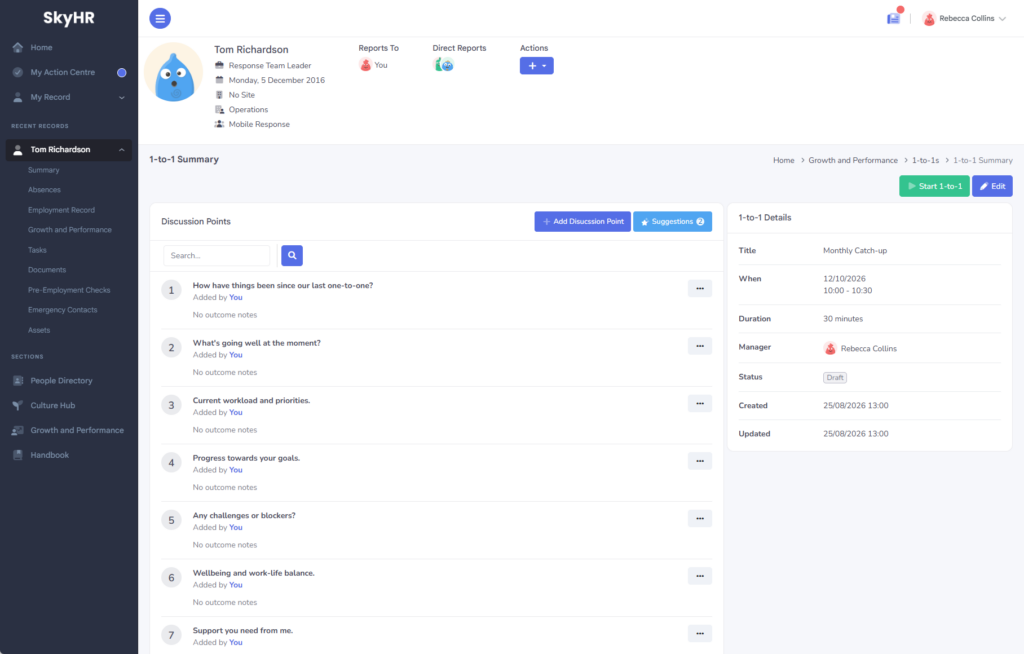
That means the agenda doesn’t have to be a list of things the manager wants to talk about. The employee has an opportunity to raise their own priorities, questions or concerns before the meeting begins.
Use existing context to prepare better questions
One of the challenges managers face when preparing for a 1-to-1 is remembering everything that might be worth discussing.
Perhaps something was agreed during the previous meeting. The employee might be approaching the deadline for a goal. They may have recently received some great feedback that deserves recognition.
The information is there, but remembering to bring all of it into the next conversation isn’t always easy.
This is where SkyHR’s AI Suggested Discussion Points can help.
Rather than simply generating a generic list of questions, SkyHR can use relevant information already held about the employee to identify potential topics for the manager to consider.
For example, it might suggest:
Follow up on leadership development
At the previous 1-to-1, you agreed that Sarah would lead the next project planning session.
Or:
Recognise recent positive feedback
Sarah recently received positive feedback about her presentation to the team.
Or it might identify a current goal that would be useful to discuss.
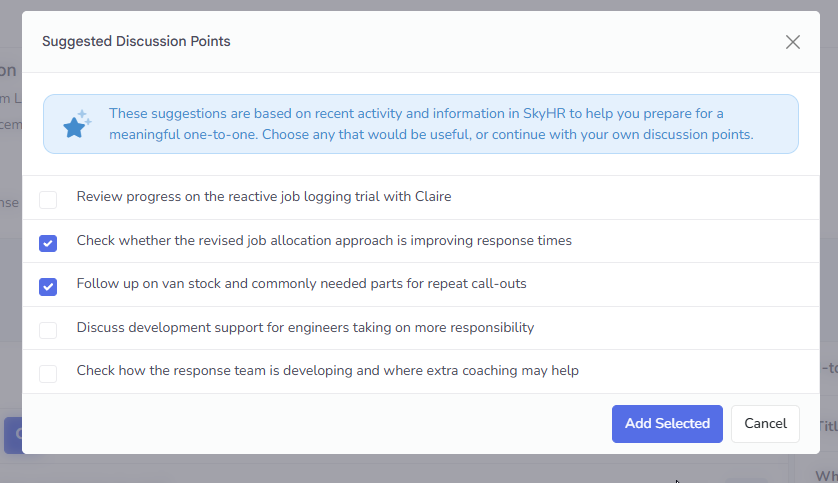
The important word here is suggested.
AI isn’t deciding what the manager and employee should discuss, and it certainly isn’t running the meeting.
The manager remains in control. They can review the suggestions, choose the ones that would make the conversation more useful and ignore the rest.
The aim is simply to help managers remember important follow-ups, recognise successes and spot useful conversations that might otherwise have been missed.
Capture outcomes, not a transcript
When the meeting starts, SkyHR switches the 1-to-1 into its active meeting view.
Each agenda item has space for the manager to record an outcome as the conversation takes place.
That doesn’t mean writing down everything that was said.
A useful outcome might be as simple as:
Workload is manageable, although the customer migration project is taking longer than expected. Agreed to prioritise the migration work this week.
That captures both the important context and what was agreed without attempting to turn the meeting into a transcript.
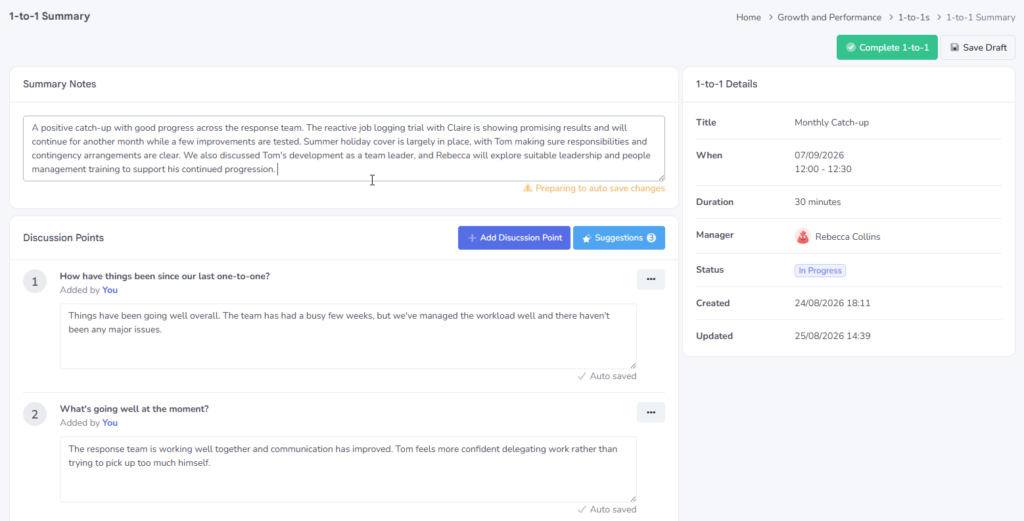
Keeping the outcome alongside the original discussion point also makes the completed record much easier to understand later.
During the 1-to-1, the system saves changes automatically. There’s no need for the manager to repeatedly stop the conversation to save their notes.
Make remote 1-to-1s collaborative too
This becomes particularly useful when a 1-to-1 is taking place remotely.
The employee can have their own view of the meeting open while the manager records outcomes.
As the manager updates the 1-to-1, the employee’s view updates, allowing them to follow the content as the conversation progresses.
That may seem small, yet it upholds a principle: the 1-to-1 record must not read as if written about an employee.
Both people actively participate in creating it.
For remote teams in particular, that helps keep the conversation and its written record connected.
Finish with a useful summary
Alongside outcomes for individual discussion points, the manager can record an overall summary of the meeting.
The summary isn’t there to repeat every item on the agenda. It’s an opportunity to capture the main themes, conclusions or overall direction of the conversation.
For example:
A positive catch-up covering current priorities, development and recent progress. Sarah is making good progress and will take the lead on the next project planning session.
The system saves the summary automatically during the meeting.
Once we have captured everything important, the manager can complete the 1-to-1.
SkyHR asks for confirmation before locking the record, giving the manager an opportunity to check everything before finishing.
The employee is then notified that the completed 1-to-1 is available to view.
Build continuity between conversations
Perhaps the biggest benefit comes over time.
A completed 1-to-1 brings the agenda, individual outcomes and overall summary together into a clear record of the conversation.
Managers can return to previous 1-to-1s and see when each of their direct reports last had one.
Instead of every meeting beginning in isolation, you start to create continuity:
Previous conversation → commitments → progress → next conversation
That history can also provide useful context when preparing for future meetings.
If an employee agreed to take on something during their previous 1-to-1, for example, SkyHR can potentially surface that as a suggested discussion point next time.
The outcome of one conversation therefore helps inform the next.
And over months rather than individual meetings, you begin to build a much clearer picture of an employee’s progress, priorities and development.
1-to-1s should create better conversations, not more admin
A good 1-to-1 should give both people space to prepare, talk openly, agree on what happens next and pick up the conversation again next time.
The software shouldn’t become the focus of the meeting.
SkyHR deliberately centres its approach to 1-to-1s on the conversation: it enables shared preparation, provides useful context, captures simple outcomes, and preserves a history you can actually return to.
The result isn’t more process around 1-to-1s.
It’s a little less administration and a little more continuity around conversations that are worth having.
Run better 1-to-1s with SkyHR
SkyHR brings 1-to-1s together with goals, feedback and the other information you’re already using to support your people.
You can try SkyHR for yourself and explore how 1-to-1s work with your team.